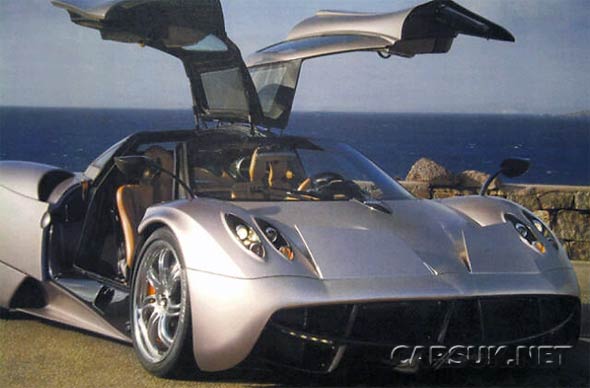
2012 Pagani Supercars Huayra The Lightest Sports Cars In Its Class
Speed is great, but a true
hypercar can dance with the best of them. Elegant and muscular the
Pagani Huayra merges the past, present and future in a timeless interpretation of
automotive art.
Pagani have officially unveiled their
2012 Huayra. The
hypercar is named after
Aymara god Huayra Tata, god of wind. Aerodynamics are a big part of the
new car which will be displayed publically for the first time at the
Geneva Auto Salon 2011. The styling of the
car was perfected over the course of 5 years to find each line's beginning and end. During this study, eight scale models were created, as well as two 1:1 models, each an evolution of the previous in a never ending quest to perfect the form and refining the substance.

The new central monocoque on the 2012 Pagani Supercars Huayra The Lightest Sports Cars In Its Class is an entirely new design made from carbontitanium. However, with the gull wing doors cutting deep into the roof, much research was focused on achieving the highest levels of rigidity through the application of new advanced composite materials and technologies first tested on the Zonda R.
2012 Pagani Supercars Huayra The Lightest Sports Cars In Its Class
The never ending quest for weight reduction resulted also into the combination of structural and non-structural or aesthetical elements. An example is the integration of all ventilation air ducts into the monocoque's structure, making the use of additional parts and ducts unnecessary. The result of this attention to detail is a vehicle weighing 1.350 kg making the
Pagani Huayra the lightest sportscar in its class.

2012 Pagani Supercars Huayra The Lightest Sports Cars In Its Class
Mercedes-AMG provides the heart for the 2012 Pagani Supercars Huayra The Lightest Sports Cars In Its Class. The 60 degree 12 cylinder turbocharged engine with a displacement of 5980 cm3 has been developed not just to meet the strictest technical and quality requirements, but also to give the car its many faces. The calm and harmony of driving one of the world's most refined GT car is interrupted when the driver calls upon the Pagani Huayra to unleash its 700 horsepower and 1000 Nm of torque. The turbos have been studied to offer immediate response to the slightest throttle input, giving the driver full control over the engine at any rpm and preventing unwanted delays in the delivery of power.

The engine's systems have been designed and tested to stand up to the most adverse conditions of temperature and performance. The 2012 Pagani Supercars Huayra The Lightest Sports Cars In Its Class has been subjected to the highs of Death Valley and the lows of the Arctic Circle. The two lateral radiators are positioned in the front to guarantee the best cooling efficiency of the intercoolers placed over the cylinder heads. Dry sump lubrication ensures an optimal oil feed to the engine even when the car is subjected to the most extreme lateral accelerations. It also regulates the oil flow so that only the necessary amount of lubricant is actually pumped into the engine from the external oil tank, reducing the friction caused by an excessive volume of lubricant inside the engine sump. An oil/water heat exchanger reduces warm-up times by heating the engine lubricant during cold start and keeps engine coolant and lubricant levels at steady operational temperatures. Extensive weight saving programs led to ingenious yet simple solutions.

2012 Pagani Supercars Huayra The Lightest Sports Cars In Its Class
The
M158 engine is homologated to meet the strictest environmental regulations, EU5 and LEV2. Despite the increase of power compared to the other
Mercedes-AMG V12 engines developed for Pagani, CO2 emissions as well as the fuel consumption have been reduced, to make the Pagani Huayra class leading amongst 12 cylinder
sports cars with values that are respective of much smaller vehicles in the market. The two stage fuel supply system features two microprocessor controlled pumps feeding fuel to the engine with the second pump only activated when necessary, thus reducing the energy required to run the fuel pumps and eliminates the waste of excessive fuel being transported and heated in the fuel lines. This efficiency combined with a large 85 liter fuel tank ensure Pagani Huayra's grand touring ability.

The power and prodigious torque generated by Pagani Huayra's V12 are transferred to the wheels through a transverse sequential seven speed gearbox and a dual plate clutch and the complete gearbox weighs only 96 kg. Keeping the weight of the rear overhang as low as possible has been a priority as we aim for a neutral behavior at the limit. A further benefit of this layout is a better behavior of the car during a rear impact. A dual clutch system was evaluated but ultimately not selected as it would have increased the weight by approximately 70kg, thus negating any minor improvement in shift-time. Xtrac already supplied the gearbox for the Zonda R and so it was the natural choice for the development of a new high performance gearbox.

Pirelli say "Power is nothing without control" and to assure complete control for the driver Pirelli has developed the bespoke P Zero tires, specifically for the 2012 Pagani Supercars Huayra The Lightest Sports Cars In Its Class. The Pirelli engineers were faced with a demanding task, combining road holding for excitement behind the steering wheel and lower rolling resistance to reduce CO2 emissions and fuel consumption. These P Zero tires are built in a dedicated MIRS� (Modular Integrated Robotized System) facility, dedicated to the production of ultrahigh performance tires and are at the forefront of what is technically possible, suited to top speeds above 370 kph as well as to lateral forces exceeding 1,5 G.

2012 Pagani Supercars Huayra The Lightest Sports Cars In Its Class
The aerodynamic
concept of the Pagani Huayra is that of a wing. The vehicle can modify the properties of this wing by varying the front ride height, which can be adjusted dynamically, and by adjusting the 4 control flaps on each of the four corners of the car. The goal is to have a neutral vehicle behavior under all conditions and control body roll via aerodynamic means. The behavior of the flaps is managed by a dedicated control unit that is fed information from the ABS and ECU, which pass information about the car's speed, yaw rate, lateral acceleration, steering angle and throttle position.

The system improves aerodynamic efficiency in a variety of driving conditions, where a low drag coefficient is not the determining factor. During braking, for example, the rear flaps and the front suspension are raised to counteract the weight transfer and balance the weight distribution between front and rear axles, allowing a better use of the rear brake force.

Another vital design tenant for the Huayra project was to ensure clean airflow over the body of the car. In addition to the downforce generated by the flaps and body, two high negative pressure areas were designed into the shape of the underbody and the diffuser at the rear, thus enhancing the aerodynamic stability and guaranteeing the 2012 Pagani Supercars Huayra The Lightest Sports Cars In Its Class downforce under all circumstances. As soon as the doors are closed the Pagani Huayra transports the occupants to a new dimension; a world that pleases and surprises the senses. Having everything at arm's length is not close enough for a vehicle with the capabilities of the Pagani Huayra.

2012 Pagani Supercars Huayra The Lightest Sports Cars In Its Class
A Pagani is able to present drivers with state of the art solutions while still drawing on the rich history that precedes it. The ever present emphasis is on a living breathing being rather than a digital one. The high definition central touchscreen is the heart of the vehicle infotainment system, controlling audio functions, satellite navigation, secondary vehicle functions and Bluetooth phone. To this date five prototypes have been built which have been conducting road tests for the past 4 years. Currently, over half a million kilometers have been covered by our
prototypes and before entering the US market we will have reached one million test kilometers.