Showing posts with label Porsche. Show all posts

Monday, February 28, 2011

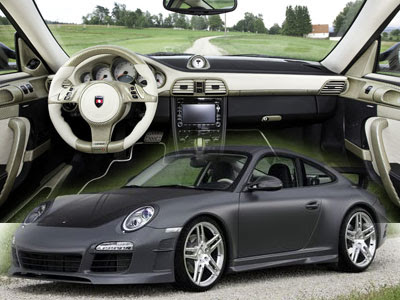
Carrera Facelift Porsche 911 Sports Car.


Carrera Facelift Porsche 911 Sports Car.

MANSORY Switzerland The High-quality refining programme for the new Porsche 911.
The company Mansory is situated in Bavaria and one of the top addresses for refining premium sports cars. Whether Bentley, Rolls-Royce, McLaren, Ferrari or Porsche � the refining specialist shows its technical talent for every automobile. The subsidiary company Mansory Switzerland AG, the in-house expert for Porsche cars, presents a comprehensive tuning programme for the model 911 from the recently revived Porsche Type 997 series at the Geneva Auto Salon 2009. This tuning programme mainly focuses on improvements concerning the aerodynamics, engine performance and handling of this sports car icon.
When developing the 911-programme, the Mansory engineers attached great importance to an individual design, but also aerodynamic efficiency. In order to save weight and guarantee highest quality standards, the body components are made of composite also, parts of the serial auto body are made of this resilient and inherently stable material. The core part of the body kit is a lift-reducing front mount in a sportive-dynamic look. In connection with the hood, the front apron offers various design possibilities. On the one hand, it forms the perfect symbiosis with the serial hood, as an especially designed inlay allows a seamless junction. And on the other hand, the apron can be combined with the Mansory carbon hood whose striking side beads demonstrate individuality and underline the sportive character of the modification. The rear apron is not less impressive: it accommodates the new four-pipe exhaust system and therefore renders a harmonic rear finish. The visual perfection of the aerodynamics pack is accomplished with the side skirts which also fulfil functional tasks. They significantly calm the air flow between both axles.
The power engines also profit from the comprehensive changes of the 911 engine range. But here, the engineers do not perform any excessive open-heart surgery, but only replace existing parts by modified proprietary developments. A new sport air filter and a new exhaust system come into operation. Especially the exhaust system renders an optimised exhaust gas flow. This enable the 911 to accelerate from 0 to 100 km/h even faster than the serial versions.
But the special highlight of the exhaust system is the integrated throttle system which - if desired - can also be operated by remote control and allows changing the sound scenery.
The refining specialist developed a forged wheel with an exclusive design which was tailor-made for Porsche requirements. The one-piece wheel with five double spokes measures 8.5 x 20 inches at the front and 12 x 20 inches the back. Not only its sportive look, but also its excellent manufacture makes it so impressive. The reduction of unsprung masses by the exceptional and elaborate production technology does not only lead to a shorter braking distance, but also improves the acceleration and the handling of the car. For best possible grip, Mansory uses Michelin Pilot Sport wheels sized 245/30 at the front and 325/25 at the rear. Moreover, the newly developed running gear which lowers the car�s centre of gravity by 30 millimetres also sets sportive accents.


Carrera Facelift Porsche 911 Sports Car.


Carrera Facelift Porsche 911 Sports Car.

MANSORY Switzerland The High-quality refining programme for the new Porsche 911.
The company Mansory is situated in Bavaria and one of the top addresses for refining premium sports cars. Whether Bentley, Rolls-Royce, McLaren, Ferrari or Porsche � the refining specialist shows its technical talent for every automobile. The subsidiary company Mansory Switzerland AG, the in-house expert for Porsche cars, presents a comprehensive tuning programme for the model 911 from the recently revived Porsche Type 997 series at the Geneva Auto Salon 2009. This tuning programme mainly focuses on improvements concerning the aerodynamics, engine performance and handling of this sports car icon.
When developing the 911-programme, the Mansory engineers attached great importance to an individual design, but also aerodynamic efficiency. In order to save weight and guarantee highest quality standards, the body components are made of composite also, parts of the serial auto body are made of this resilient and inherently stable material. The core part of the body kit is a lift-reducing front mount in a sportive-dynamic look. In connection with the hood, the front apron offers various design possibilities. On the one hand, it forms the perfect symbiosis with the serial hood, as an especially designed inlay allows a seamless junction. And on the other hand, the apron can be combined with the Mansory carbon hood whose striking side beads demonstrate individuality and underline the sportive character of the modification. The rear apron is not less impressive: it accommodates the new four-pipe exhaust system and therefore renders a harmonic rear finish. The visual perfection of the aerodynamics pack is accomplished with the side skirts which also fulfil functional tasks. They significantly calm the air flow between both axles.
The power engines also profit from the comprehensive changes of the 911 engine range. But here, the engineers do not perform any excessive open-heart surgery, but only replace existing parts by modified proprietary developments. A new sport air filter and a new exhaust system come into operation. Especially the exhaust system renders an optimised exhaust gas flow. This enable the 911 to accelerate from 0 to 100 km/h even faster than the serial versions.
But the special highlight of the exhaust system is the integrated throttle system which - if desired - can also be operated by remote control and allows changing the sound scenery.
The refining specialist developed a forged wheel with an exclusive design which was tailor-made for Porsche requirements. The one-piece wheel with five double spokes measures 8.5 x 20 inches at the front and 12 x 20 inches the back. Not only its sportive look, but also its excellent manufacture makes it so impressive. The reduction of unsprung masses by the exceptional and elaborate production technology does not only lead to a shorter braking distance, but also improves the acceleration and the handling of the car. For best possible grip, Mansory uses Michelin Pilot Sport wheels sized 245/30 at the front and 325/25 at the rear. Moreover, the newly developed running gear which lowers the car�s centre of gravity by 30 millimetres also sets sportive accents.


Wednesday, February 16, 2011

Porche Cars 2012 - Porsche Panamera S Hybrid 2012 pictures

Porsche Cars 2012 - Porsche Panamera S Hybrid 2012 pictures
 Porsche Cars 2012 - Porsche Panamera S Hybrid 2012 pictures


 Porsche Cars 2012 - Porsche Panamera S Hybrid 2012 pictures
 Porsche Cars 2012 - Porsche Panamera S Hybrid 2012 pictures
Porsche Cars 2012 - Porsche Panamera S Hybrid 2012 pictures

Wednesday, February 2, 2011

Porsche Boxster S Black Edition 2011 pictures - Black Porsche Boxster S 2011

Porsche Boxster S Black Edition 2011 pictures - Black Porsche Boxster S 2011
 Porsche Boxster S Black Edition 2011 pictures - Black Porsche Boxster S 2011


 Porsche Boxster S Black Edition 2011 pictures - Black Porsche Boxster S 2011

 Porsche Boxster S Black Edition 2011 pictures - Black Porsche Boxster S 2011


 Porsche Boxster S Black Edition 2011 pictures - Black Porsche Boxster S 2011
Porsche Boxster S Black Edition 2011 pictures - Black Porsche Boxster S 2011

Porsche 911 Black Edition Coupe 2012 pictures - 2012 Porsche 911

Porsche 911 Black Edition Coupe 2012 pictures - 2012 Porsche 911
 Porsche 911 Black Edition Coupe 2012 pictures - 2012 Porsche 911


 Porsche 911 Black Edition Coupe 2012 pictures - 2012 Porsche 911

 Porsche 911 Black Edition Coupe 2012 pictures - 2012 Porsche 911

 Porsche 911 Black Edition Coupe 2012 pictures - 2012 Porsche 911
Porsche 911 Black Edition Coupe 2012 pictures - 2012 Porsche 911

Saturday, January 15, 2011

2010 Porsche Sports Cars 911 GT3 R Hybrid

Known as the 2010 Porsche 911 GT3 R Hybrid, the model hints at new hybrid technology that Porsche Sports Cars will use in its motorsport ventures. According to Porsche, the 911 GT3 R Hybrid will be used as a study to gather information about how hybrid drive will behave under a racing environment and will also help the German automaker study how it can be applied to its road cars.
2010 Porsche 911 GT3 R Hybrid
During Porsche's press conference here at the Geneva Motor Show, most of our attention was understandably on the 918 Spyder Concept, but the German automaker had several other significant debuts. One was the 911 GT3 R Hybrid, Porsche's first race car to feature electric power sourced from a duo of motors that send power to a generator attached the flywheel. Like many hybrid production cars, the motors are charged whenever the brakes are applied, and the driver can use the extra power for 6-8 seconds for overtaking.
Exactly 110 years after Ferdinand Porsche developed the world's first car with hybrid drive, the Lohner Porsche Semper Vivus, Dr. Ing. h.c. F. Porsche AG, Stuttgart, is once again taking up this visionary drive concept in production-based GT racing: During the Geneva Motor Show, a Porsche Sports Cars 911 GT3 R with innovative hybrid drive is making its debut, opening up a new chapter in the history of Porsche with more than 20,000 wins in 45 years scored by the extremely successful Porsche 911 in racing trim.
Unlike a conventional battery-electric hybrid system the Porsche 911 GT3 R uses a flywheel system, which gathers kinetic energy under braking to power two electric-motors that are mounted in a single assembly and are connected to the front wheel. After each boost of charge, the two motors provide 6 to 8 second jolts of power. The extra power is engaged by pressing a button on the steering wheel, providing up to 161-hp to the front wheels, assisting the 911 GT3 R Hybrid�s 480-hp 4.0L inline-6 that powers the two rear-wheels.
The innovative hybrid technology featured in the car has been developed especially for racing, standing out significantly in its configuration and components from conventional hybrid systems. In this case, electrical front axle drive with two electric motors developing 60 kW each supplements the 480-bhp four-litre flat-six at the rear of the 911 GT3 R Hybrid. A further significant point is that instead of the usual batteries in a hybrid road car, an electrical flywheel power generator fitted in the interior next to the driver delivers energy to the electric motors.
The flywheel generator itself is an electric motor with its rotor spinning at speeds of up to 40,000 rpm, storing energy mechanically as rotation energy. The flywheel generator is charged whenever the driver applies the brakes, with the two electric motors reversing their function on the front axle and acting themselves as generators. Then, whenever necessary, that is when accelerating out of a bend or when overtaking, the driver is able to call up extra energy from the charged flywheel generator, the flywheel being slowed down electromagnetically in the generator mode and thus supplying up to 120 kW to the two electric motors at the front from its kinetic energy.
This additional power is available to the driver after each charge process for approximately 6 - 8 seconds. Energy formerly converted - and thus wasted - into heat upon every application of the brakes, is now highly efficiently converted into additional drive power.
Depending on racing conditions, hybrid drive is used in this case not only for extra power, but also to save fuel. This again increases the efficiency and, accordingly, the performance of the 911 GT3 R Hybrid, for example by reducing the weight of the tank or making pitstops less frequent.
After its debut in Geneva the 911 GT3 R Hybrid will be tested in long-distance races on the N�rburgring. The highlight of this test programme will be the 24 Hours on the Nordschleife of N�rburgring on May 15th and 16th. The focus is not on the 911 GT3 R Hybrid winning the race, but rather serving as a spearhead in technology and a 'racing laboratory' providing know-how on the subsequent use of hybrid technology in road-going sports cars.
The 911 GT3 R Hybrid is a perfect example of the Porsche Intelligent Performance philosophy, a principle to be found in every Porsche: More power on less fuel, more efficiency and lower CO2 emissions - on the track and on the road.

2010 Porsche Sports Cars 911 GT3 R Hybrid

Known as the 2010 Porsche 911 GT3 R Hybrid, the model hints at new hybrid technology that Porsche Sports Cars will use in its motorsport ventures. According to Porsche, the 911 GT3 R Hybrid will be used as a study to gather information about how hybrid drive will behave under a racing environment and will also help the German automaker study how it can be applied to its road cars.
2010 Porsche 911 GT3 R Hybrid
During Porsche's press conference here at the Geneva Motor Show, most of our attention was understandably on the 918 Spyder Concept, but the German automaker had several other significant debuts. One was the 911 GT3 R Hybrid, Porsche's first race car to feature electric power sourced from a duo of motors that send power to a generator attached the flywheel. Like many hybrid production cars, the motors are charged whenever the brakes are applied, and the driver can use the extra power for 6-8 seconds for overtaking.
Exactly 110 years after Ferdinand Porsche developed the world's first car with hybrid drive, the Lohner Porsche Semper Vivus, Dr. Ing. h.c. F. Porsche AG, Stuttgart, is once again taking up this visionary drive concept in production-based GT racing: During the Geneva Motor Show, a Porsche Sports Cars 911 GT3 R with innovative hybrid drive is making its debut, opening up a new chapter in the history of Porsche with more than 20,000 wins in 45 years scored by the extremely successful Porsche 911 in racing trim.
Unlike a conventional battery-electric hybrid system the Porsche 911 GT3 R uses a flywheel system, which gathers kinetic energy under braking to power two electric-motors that are mounted in a single assembly and are connected to the front wheel. After each boost of charge, the two motors provide 6 to 8 second jolts of power. The extra power is engaged by pressing a button on the steering wheel, providing up to 161-hp to the front wheels, assisting the 911 GT3 R Hybrid�s 480-hp 4.0L inline-6 that powers the two rear-wheels.
The innovative hybrid technology featured in the car has been developed especially for racing, standing out significantly in its configuration and components from conventional hybrid systems. In this case, electrical front axle drive with two electric motors developing 60 kW each supplements the 480-bhp four-litre flat-six at the rear of the 911 GT3 R Hybrid. A further significant point is that instead of the usual batteries in a hybrid road car, an electrical flywheel power generator fitted in the interior next to the driver delivers energy to the electric motors.
The flywheel generator itself is an electric motor with its rotor spinning at speeds of up to 40,000 rpm, storing energy mechanically as rotation energy. The flywheel generator is charged whenever the driver applies the brakes, with the two electric motors reversing their function on the front axle and acting themselves as generators. Then, whenever necessary, that is when accelerating out of a bend or when overtaking, the driver is able to call up extra energy from the charged flywheel generator, the flywheel being slowed down electromagnetically in the generator mode and thus supplying up to 120 kW to the two electric motors at the front from its kinetic energy.
This additional power is available to the driver after each charge process for approximately 6 - 8 seconds. Energy formerly converted - and thus wasted - into heat upon every application of the brakes, is now highly efficiently converted into additional drive power.
Depending on racing conditions, hybrid drive is used in this case not only for extra power, but also to save fuel. This again increases the efficiency and, accordingly, the performance of the 911 GT3 R Hybrid, for example by reducing the weight of the tank or making pitstops less frequent.
After its debut in Geneva the 911 GT3 R Hybrid will be tested in long-distance races on the N�rburgring. The highlight of this test programme will be the 24 Hours on the Nordschleife of N�rburgring on May 15th and 16th. The focus is not on the 911 GT3 R Hybrid winning the race, but rather serving as a spearhead in technology and a 'racing laboratory' providing know-how on the subsequent use of hybrid technology in road-going sports cars.
The 911 GT3 R Hybrid is a perfect example of the Porsche Intelligent Performance philosophy, a principle to be found in every Porsche: More power on less fuel, more efficiency and lower CO2 emissions - on the track and on the road.

Thursday, January 13, 2011

2011 New Porsche Sports Car 911 GT2 RS

ATLANTA � May 12, 2010 � The time: seven minutes, 18 seconds on the N�rburgring-Nordschleife. The power: 620 hp. The weight: 3,020 lb (1,370 kilograms) in road trim with all fluids on board. The car: the new 2011 Porsche 911 GT2 RS.
2011 Porsche Sports Car 911 GT2 RS
After a couple of leaks here and there, the 2011 Porsche 911 GT2 RS has finally been revealed. The new 911 GT2 RS will make its world debut in August at the Moscow Auto Show and will go on sale in the U.S. in October with a starting price tag of $245,000.
Following a bevy of leaks this past week, Porsche went ahead today and officially introduced its new 911 GT2 RS supercar to the world. Quick facts: it gets a twin turbocharged flat-six with 620HP and at the same time it's a whopping 70kg or 154 lbs lighter than the prior 911 GT2.
The future top GT model marking the absolute climax in the 911 range is the fastest and most powerful road-going sports car ever built in the history of Dr. Ing. h.c. F. Porsche AG, Stuttgart. With power up by 90 hp and weight down by 70 kilograms or 154 lb in comparison with the 911 GT2, the new 911 GT2 RS has a power-to-weight ratio of just 2.21 kilos or 4.9 lb per horsepower, by far the best power/weight ratio in its class.
Obviously, these are the ideal ingredients for an ultra-high-performance sports car with supreme agility, truly blistering performance on the road, and of course exemplary Porsche Intelligent Performance. For despite this extra power and performance, fuel consumption and CO2 emissions versus the 911 GT2 are down by approximately 5 per cent to 11.9 ltr/100 km (equal to 23.7 mpg imp) and 284 g/km.
The 3.6 litre six-cylinder boxer engine boosted by two turbochargers with variable turbine geometry exclusive to Porsche in its combination with a gasoline engine drives the rear wheels via a six-speed manual gearbox. Developed especially for the 911 GT2 RS, sports tyres measuring 325/30 ZR 19 convert this massive power into equally massive performance and acceleration on the road: 0 to 100 km/h in 3.5 seconds, 0 to 200 km/h in just 9.8 seconds, and 0 to 300 km/h in 28.9 seconds. Top speed is 330 km/h.
Stuttgart's team has equipped the GT2 RS with lightweight yet carbon-ceramic brakes and a new set of 19-inch wheels (available in three different shades) wrapped in tires size 245/35 up front and 325/30 at the back that were specifically developed for this sports car. In addition, the 911 GT2 RS gets a new set-up of the springs, PASM Porsche Adaptive Suspension Management, anti-roll bars, as well as the engine mounts and PSM Porsche Stability Management.
In its exterior styling, the RS stands out from the standard 911 GT2 through the use of carbon fiber components in matt-black surface finish, the wider wheels and flared wheel arches at the front, the redesigned front lip spoiler and the 10 millimeter or about 0.4 inches taller rear wing.
The car's interior has outfitted with a pair of lightweight bucket seats made of carbon-fibre-reinforced plastic in carbon surface finish and lightweight door panels with door opening straps. The basic black color of the interior is contrasted by the red finish of the seat centre sections and the roof lining as well as segments on the steering wheel rim which like the gearshift and handbrake lever are covered in alcantara.
Depending on your needs and desires, Porsche also offers an optional Clubsport package that includes a safety roll bar, a six-point harness, and pre-wiring for a kill switch, as well as the option to replace the racing seats with electrically adjustable sport seats and add a navi system.
Price is not going to be cheap for the Ultimate 911. European prices are going to start above �240,000 and no comparable price for America is yet to be released. The GT2 RS should start production in September. The 911 GT2 RS will be available in Europe from September 2010, in the USA from October 2010. The Euro base price is 199,500.- Euro. Including VAT and national specifications/equipment the new 911 GT2 RS will retail in Germany at a price of 237,578 Euro.
Production of the 911 GT2 RS will be limited to 500 units, with Europe getting it first in September at a base price of �199,500 (Germany: �237,578 or US$301,398, UK: �164,107 or US$245,097), and the U.S. in October at a price of US$245,000 (�193,126), and will be debuting at the Moscow Auto Show on August 25th 2010.